
Roti and Naan Prices Announced for Ramadan: Rates to Remain Unchanged Until 30th Ramazan

Roti and Naan Prices Announced for Ramadan
The Pakistan Naanbai Association has officially confirmed that roti and naan prices will remain unchanged throughout the holy month of Ramazan until 30th Ramazan. This announcement comes at a time when the cost of essential inputs such as flour, ghee, LPG, electricity, and labor has increased sharply. The decision aims to provide relief to the public during Ramazan, when food expenses typically rise for households.
Roti & Naan Prices 2026
Prices remain stable during Ramazan until 30th Ramazan to protect public interest

Price Stability
Roti and naan prices frozen during Ramazan
- Prices frozen until 30th Ramazan
- Decision made despite rising costs
- Public relief prioritized
Decision Authority
Pakistan Naanbai Association oversees pricing policy

- General Council approval
- Participation from multiple districts
- Unified pricing policy
Leadership Role
Central President guides price stability decisions
- Meeting chaired by Central President
- Focus on public convenience
- Temporary relief strategy
Post-Eid Price Changes
Expected price increases after Eidul Fitr

- Rs. 5 increase for roti and naan
- Rs. 10 increase for paratha and roghni naan
- Implementation after Eidul Fitr
Rising Costs
Flour, LPG, labor, and electricity costs increase
- 79-kg flour bag: Rs. 11,700
- Fine flour: Rs. 12,600
- LPG cylinder price at Rs. 16,000
Business Risks
Financial sustainability and tandoor closures post-Ramazan
- Reduced profit margins
- Risk of operational losses
- Urgent need for policy support
Despite growing financial pressure on tandoor owners, the association decided to maintain existing prices in the interest of consumers. The leadership acknowledged the difficulties faced by naanbais but emphasized social responsibility during the holy month.
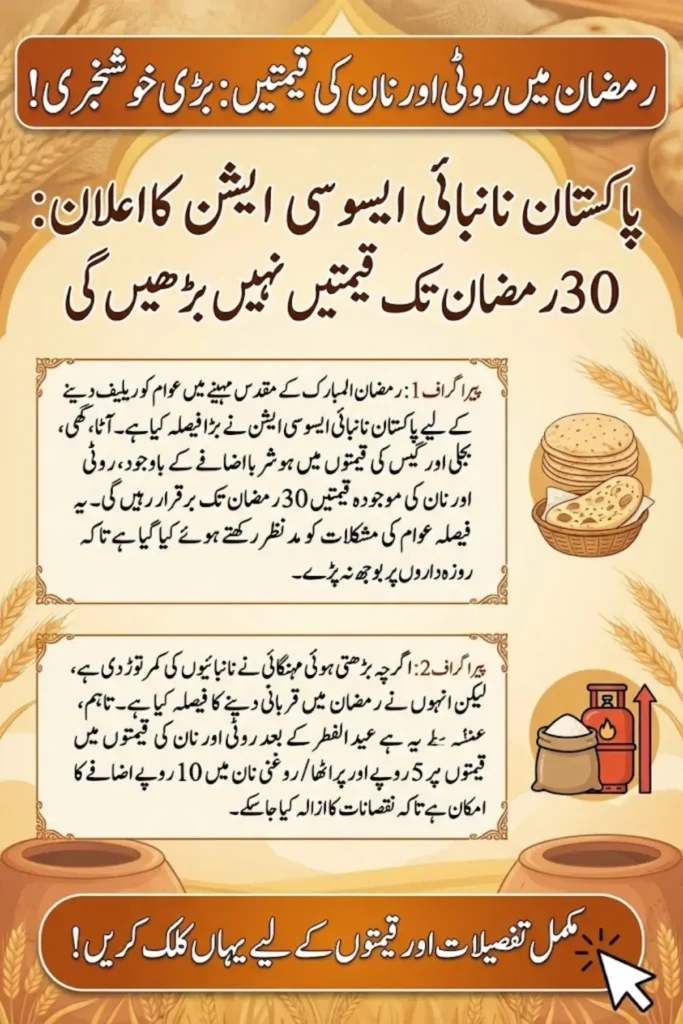
- Prices frozen until 30th Ramazan
- Decision made despite rising costs
- Public relief prioritized during Ramazan
Also Read: How To Receive BISP 8171 February Payment Via JazzCash and EasyPaisa
Decision Taken by Pakistan Naanbai Association
The decision to keep roti and naan prices stable was taken during a General Council meeting of the Pakistan Naanbai Association. Representatives from multiple regions participated to ensure that the policy reflected collective concerns and realities across different districts.
The meeting included delegates from Rawalpindi, Attock, Jhelum, Chakwal, Murree, Talagang, and surrounding areas. This broad representation ensured uniformity in pricing across these regions during Ramazan.
- General Council approval
- Participation from multiple districts
- Unified pricing policy
Also Read: Punjab Interest-Free Loan Scheme for Women Entrepreneurs: PSIC to Offer 5 Lakh Support
Leadership Role in Price Stability Announcement
The General Council meeting was chaired by Central President Shafiq Qureshi, who played a key role in guiding the discussion. He highlighted the importance of maintaining price stability during Ramazan, even as production costs continue to rise.
According to the association’s leadership, the decision was not easy but was taken after considering public welfare. The leadership stressed that this temporary relief would help families manage daily food expenses during the holy month.
- Meeting chaired by Central President
- Focus on public convenience
- Temporary relief strategy
Also Read: Maryam Nawaz Ration Card 2026 – How to Apply Online & CNIC Verification Guide
Post-Eid Increase in Roti and Naan Prices
While prices will remain unchanged during Ramazan, the association has confirmed that increases will be implemented after Eidul Fitr. This step is being taken to recover losses incurred due to rising operational costs.
After Eid, roti and naan prices are expected to increase by Rs. 5 each. Paratha and roghni naan will see a higher increase of Rs. 10, reflecting their higher production costs.
- Rs. 5 increase for roti and naan
- Rs. 10 increase for paratha and roghni naan
- Implementation after Eidul Fitr
Also Read: Punjab Laptop Scheme 2026 – Apply Online, University List & Eligibility Details
Sharp Rise in Flour Prices
One of the major challenges highlighted by the Pakistan Naanbai Association is the sharp increase in flour prices. According to the association, the cost of a 79-kg flour bag has increased significantly over a short period.
Fine flour prices have also risen sharply, adding further pressure on tandoor operations. The association warned that prices may rise even further by the end of Ramazan.
| Flour Type | Previous Price | Current Price |
|---|---|---|
| 79-kg Flour Bag | Rs. 7,600 | Rs. 11,700 |
| Fine Flour | Rs. 8,200 | Rs. 12,600 |
Expected Further Increase in Flour Costs
The association has cautioned that flour prices may increase by up to Rs. 2,200 per bag by the end of Ramazan. Such an increase would make it even harder for naanbais to continue operations at current prices.
This expected hike has raised serious concerns within the association, as flour is the primary raw material for roti and naan production.
- Possible Rs. 2,200 increase per bag
- Major impact on production costs
- Increased financial pressure
Rising LPG, Labor, and Utility Expenses
In addition to flour, the cost of commercial LPG cylinders has also surged. According to the association, LPG prices have reached Rs. 16,000 per cylinder, significantly increasing daily operational expenses for tandoors.
Labor wages, electricity bills, and tandoor rents have also increased, further straining business sustainability. These combined costs have made it difficult for naanbais to operate profitably.
- LPG cylinder price at Rs. 16,000
- Increased labor wages
- Higher electricity and rent expenses
Financial Unsustainability of Current Prices
The Pakistan Naanbai Association stated that continuing operations at existing prices has become financially unsustainable. Many tandoor owners are operating at minimal margins or losses during Ramazan.
The association warned that without cost control measures, naanbais may not be able to absorb losses beyond the holy month. This situation could affect the availability of affordable roti and naan after Eid.
- Reduced profit margins
- Risk of operational losses
- Long-term sustainability concerns
Criticism of District Administration
The association criticized the district administration for failing to control the rising prices of essential inputs. According to the leadership, a lack of effective monitoring has allowed unchecked increases in flour and utility costs.
They urged authorities to intervene and stabilize prices to protect both consumers and small food businesses. Without administrative support, the situation may worsen after Eid.
- Alleged lack of price control
- Call for government intervention
- Need for regulatory oversight
Also Read: Final Reminder! 1 Day Left To Apply in PM Electric Bike Scheme 2026
Warning of Tandoor Closures After Eid
The Pakistan Naanbai Association warned that continued cost pressure could force many tandoors to shut down after Eidul Fitr. Such closures would directly affect daily wage workers and local food supply.
The association emphasized that timely action by authorities could prevent closures and ensure continued availability of affordable food items.
- Risk of tandoor shutdowns
- Impact on workers and consumers
- Urgent need for policy support
Also Read: Punjab E-Bike Scheme 2026 Apply Now for Subsidized Electric Bikes
Conclusion
The announcement that roti and naan prices will remain unchanged until 30th Ramazan offers temporary relief to the public during the holy month. However, rising input costs have placed immense pressure on naanbais, making post-Eid price increases unavoidable.
Without effective intervention from authorities to control costs, the sustainability of tandoor businesses remains at risk. Balancing public relief with business viability will be crucial in the coming weeks.
Also Read: PM Laptop Scheme Phase IV 2026 Required Documents and Eligibility
FAQs
Why will roti and naan prices remain unchanged during Ramazan?
The Pakistan Naanbai Association decided to keep prices stable to provide relief to the public during the holy month.
When will roti and naan prices increase?
Prices are expected to increase after Eidul Fitr, with roti and naan rising by Rs. 5.
What is causing the increase in production costs?
Rising flour prices, LPG costs, labor wages, electricity bills, and tandoor rents are the main reasons.





Is there a risk of tandoor closures after Eid?
Yes, the association has warned that continued cost pressure could force some tandoors to shut down.
Also Read: BISP 8171 Verification 2026 Started For Recently Surveyed Women