PAVE Scheme 2026: Apply Online, Eligibility, Subsidy & Complete Guide
Pakistan’s PAVE Scheme is the government’s main subsidy program for switching to electric bikes, rickshaws, and loaders, and it changed substantially in 2026. If you’re trying to figure out how much you’d save, whether you qualify, and how to actually apply, here’s a current, practical breakdown of the program — including what changed between its first and second phases.
What Is the PAVE Scheme?
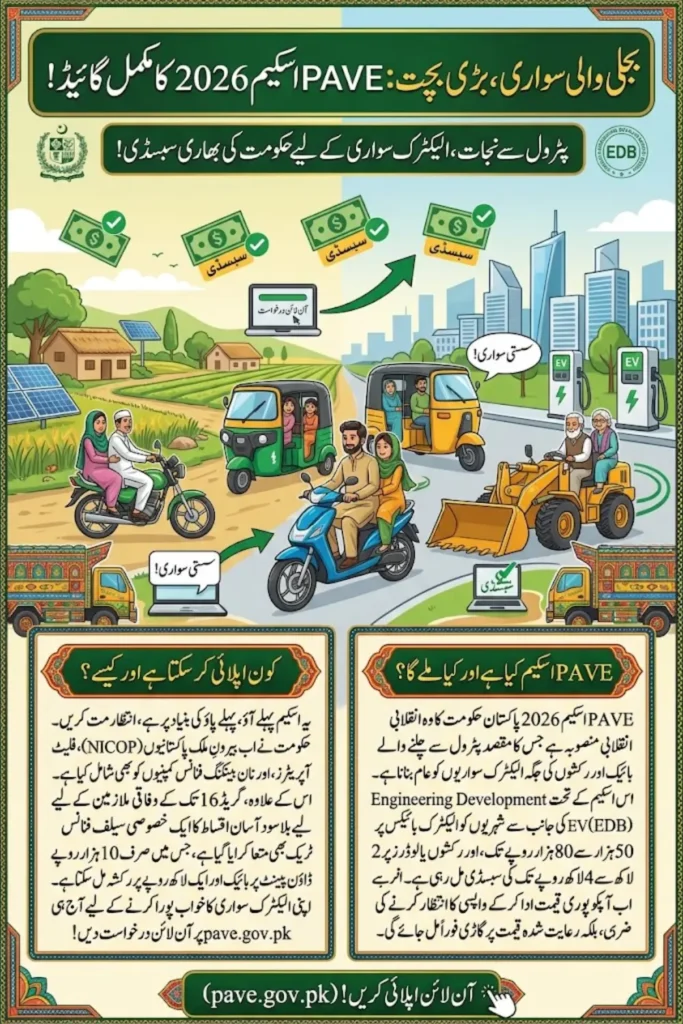
PAVE stands for Pakistan Accelerated Vehicle Electrification. It’s a federal subsidy program run by the Engineering Development Board (EDB) under the Ministry of Industries & Production, operating under the New Energy Vehicles (NEV) Policy 2025–30. The goal is straightforward: make electric two- and three-wheelers cheaper than their petrol equivalents so ordinary buyers actually switch, rather than relying on awareness campaigns alone.
The program is funded on a revenue-neutral basis through the NEV Adoption Levy Act 2025, which applies a small climate-support levy (Rs 2.5 per litre) on petrol and diesel sold nationwide. Over its planned five-year run through 2030, the broader NEV Policy envisions a total subsidy pool of roughly Rs 100 billion covering electric bikes, rickshaws, loaders, cars, buses, and trucks — though the bulk of activity so far has centered on two- and three-wheelers, which is what this guide focuses on.
Applications are processed only through the official portal, pave.gov.pk. Be cautious of third-party websites that look similar or claim to process registrations on your behalf — the only place to submit an actual application is the official government portal.
PAVE Scheme 2026 Subsidy Amounts
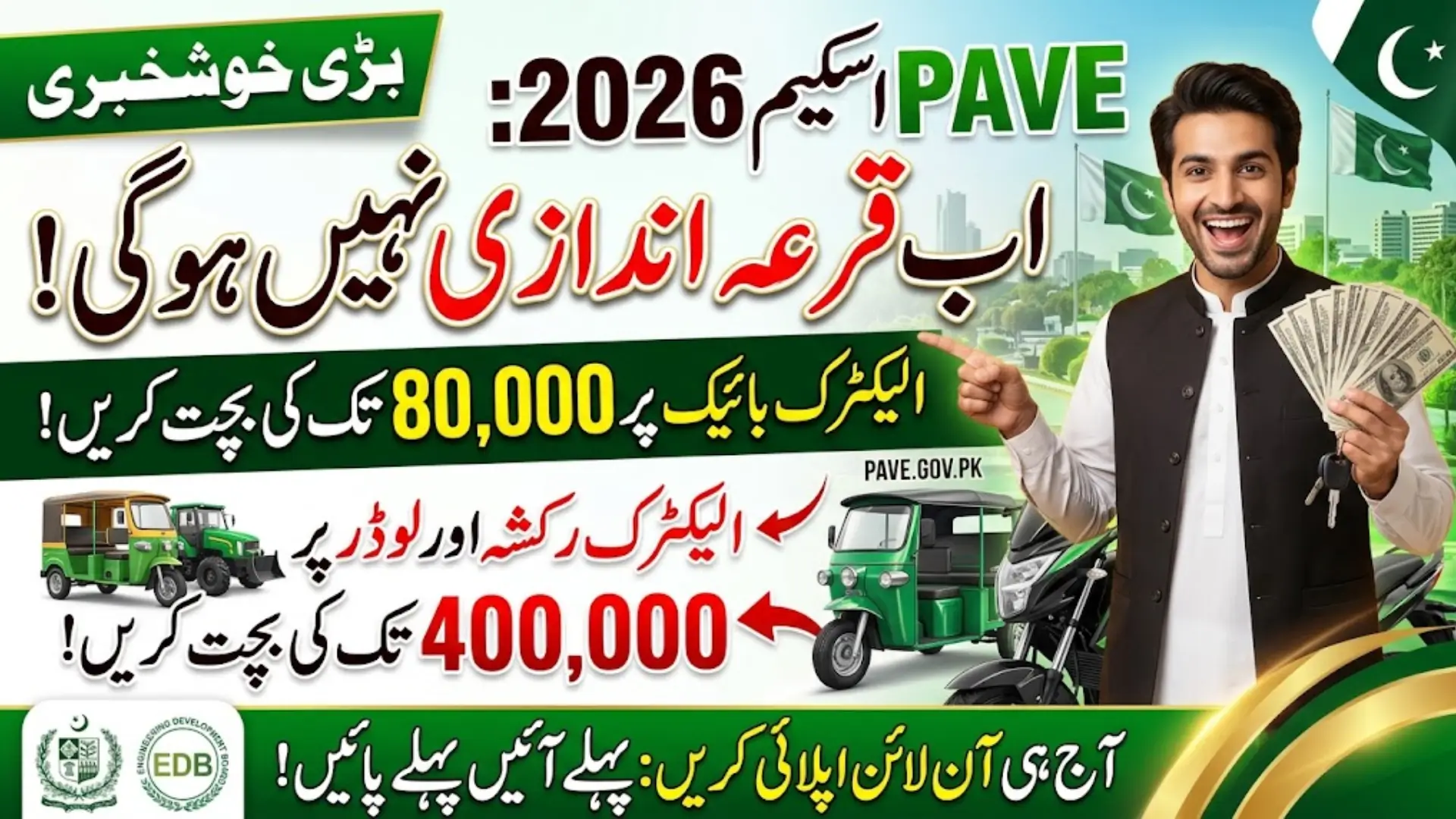
The subsidy amount depends on your vehicle type and how you’re financing the purchase — buying outright (self-finance) generally carries a higher subsidy than financing through a partner bank’s lease.
| Vehicle Type | Bank-Lease Subsidy | Self-Finance Subsidy |
|---|---|---|
| Electric two-wheeler (bike) | Rs 50,000 | Rs 80,000 |
| Electric three-wheeler (rickshaw/loader) | Rs 200,000 | Rs 400,000 |
These figures come from the program’s official balloting announcement and remain the reference subsidy structure for the scheme. The exact net price you pay depends on the specific approved model and OEM you choose, since base prices vary across manufacturers.
Under Phase 2, the payment mechanics also changed: instead of paying the full sticker price upfront and being reimbursed later, buyers now pay the net price after the subsidy is deducted. The EDB transfers the subsidy amount directly to the manufacturer (OEM) through the State Bank of Pakistan, once delivery and registration are verified. This is a meaningful improvement — it removes the cash-flow burden that discouraged many applicants during Phase 1.
Phase 1 vs Phase 2: What Actually Changed
Phase 1 of the scheme (FY2025-26) targeted 41,000 vehicles — 40,000 electric bikes and 1,000 rickshaws/loaders — and allocated them through computerized e-balloting. The first balloting round drew from 269,161 applications and allocated all 41,000 slots. That phase has since closed.
Weak participation from partner banks slowed down disbursement under Phase 1, which is what prompted the government to revise the program. The Economic Coordination Committee (ECC) approved Phase 2 in May 2026 with a Rs 9 billion package for the fiscal year, targeting an additional 76,000 electric bikes and 2,170 rickshaws/loaders — bringing the full-year target to 119,170 vehicles.
| Feature | Phase 1 | Phase 2 |
|---|---|---|
| Allocation method | Computerized balloting | First-come, first-served |
| Vehicle target | 41,000 (40,000 bikes + 1,000 three-wheelers) | 76,000 bikes + 2,170 three-wheelers |
| Payment flow | Full price paid upfront, reimbursed later | Net price paid after subsidy deduction |
| Verification | 100% third-party verification | Risk-based (biometric, photo, digital checks) |
| Government employee track | Not specifically featured | Dedicated self-finance track for BS-16 and below |
| Access | Individual applicants | Expanded to overseas Pakistanis (NICOP/POC), SECP-registered NBFCs, and fleet operators |
Under Phase 2, applicants who were waitlisted during Phase 1 are prioritized first, based on their original application timestamp, followed by new applicants in the order they registered. The ECC also signaled a further fast-track rollout of 100,000 additional electric bikes, with the EDB having already invited manufacturers to prequalify for it — so the total pool of available subsidies is likely to keep expanding through 2026.
A note on timing: no fixed application closing date has been officially confirmed by the EDB for the ongoing phase. Because allocation is first-come-first-served against a capped quota, the practical “deadline” is whenever the vehicle allocation runs out — not a calendar date. Treat any specific closing date you see quoted elsewhere with caution, and check the live status on pave.gov.pk before assuming a deadline applies.
Who Can Apply — Eligibility Criteria
Based on the program’s public criteria, applicants are generally expected to:
- Be a Pakistani citizen with a valid CNIC (this includes applicants from Azad Jammu & Kashmir and Gilgit-Baltistan)
- Fall within the program’s specified adult age range
- Not already hold an active allocation from an earlier PAVE balloting round for the same vehicle category
- Provide accurate personal and financial details matching official records
Phase 2 also widened who can access the program beyond individual retail applicants, opening it to overseas Pakistanis holding NICOP or POC documentation, SECP-registered non-banking finance companies, and registered fleet operators, alongside a dedicated track for federal government employees in Basic Scale 16 and below (covered in the next section). A women’s quota is also part of the scheme’s design, intended to encourage female participation in EV adoption.
Because eligibility details can be refined between application rounds, always confirm the current criteria on the official portal before you start your application — this guide reflects the structure of the program as publicly announced, but specific thresholds (age limits, income caps, or category-specific rules) should be checked live.
Documents Required for PAVE Registration
Keep the following ready before you start:
- Original CNIC (front and back scan or clear photo)
- Valid mobile number registered in your name, for OTP verification
- Passport-size photograph in the specified format
- Bank account details, if you’re applying through the bank-lease route
- Proof of employment, if applying through the government-employee self-finance track
- NICOP/POC documentation, if applying as an overseas Pakistani
Having these ready in the correct file format before you start reduces the chance of your application being delayed for incomplete documentation.
How to Apply for the PAVE Scheme Online
- Visit the official portal. Go to pave.gov.pk directly — don’t use links shared through unofficial social media pages.
- Create your account. Register using your CNIC number and an active mobile number; you’ll receive an OTP for verification.
- Select your vehicle category and financing route. Choose between electric bike, rickshaw, or loader, and decide between self-finance or bank-lease.
- Choose your preferred OEM/model. Pick from the list of approved manufacturers and models available in your category.
- Upload your documents. Submit your CNIC scan, photograph, and any category-specific documents (employment proof, NICOP, etc.).
- Review and submit. Double-check every field — mismatched CNIC or bank details are among the most common reasons applications get held up during verification.
- Track your status. Use your CNIC or application ID to check your status on the portal; under the current first-come-first-served model, your position in the queue is set by your submission timestamp.
If you’re using bank financing, expect an additional step where your chosen partner bank verifies your application and approves the lease before delivery is scheduled.
Special Track for Government Employees (BS-16 and Below)
Phase 2 introduced a dedicated self-finance option for federal government employees in Basic Scale 16 and below:
- Down payment: Rs 10,000 for an electric bike, or Rs 100,000 for a rickshaw/loader
- Repayment: The remaining balance is recovered through interest-free payroll deductions, spread over 6 to 18 months
- No bank involvement required for this track, since recovery happens directly through salary
This route is worth considering if you’re a qualifying employee, since it avoids bank processing time and interest charges entirely.
How the Subsidy Is Now Paid Out
Under the revised Phase 2 process, you don’t pay the full vehicle price and wait for reimbursement. Instead:
- You pay the OEM’s price minus your subsidy amount at the point of purchase.
- The vehicle is delivered and registered in your name.
- Once delivery and registration are verified, the EDB transfers the subsidy directly to the OEM through the State Bank of Pakistan.
Verification itself has also moved to a risk-based model — combining biometric checks, photographic evidence, and digital validation through the portal — replacing the earlier requirement for 100% third-party physical verification of every application. This is designed to speed up processing while still catching fraudulent claims.
Common Mistakes and Things to Verify Before You Apply
- Don’t assume a fixed deadline exists. As of now, Phase 2 has no officially announced closing date — it’s quota-based, not date-based.
- Don’t rely on third-party “PAVE” websites for applying. Several unofficial sites carry PAVE-related content or even similar-sounding domain names; only pave.gov.pk processes actual applications.
- Confirm your OEM is officially approved. Subsidies apply only to vehicles from manufacturers pre-qualified by the EDB for the current phase.
- Match your CNIC and bank details exactly. Discrepancies are a common cause of processing delays.
- If you were waitlisted in Phase 1, don’t re-register from scratch — Phase 2 is meant to carry forward waitlisted applicants by their original timestamp; check your existing application status first.
Frequently Asked Questions
Is there a last date to apply for the PAVE Scheme 2026?
No fixed closing date has been officially announced for the current phase. Because vehicles are allocated first-come, first-served against a capped quota, applications effectively close once that quota is filled rather than on a set calendar date. Always check pave.gov.pk for the live status of your category.
How much subsidy do I get on an electric bike?
The standard subsidy is Rs 80,000 if you’re paying in full yourself (self-finance) or Rs 50,000 if you’re financing through a partner bank’s lease. The exact amount you receive is fixed regardless of which approved model you choose, though the final price still depends on the OEM’s base price.
Has balloting been replaced?
Yes. Phase 1 used computerized balloting, but Phase 2, approved by the ECC in May 2026, moved to a first-come-first-served allocation model. Waitlisted Phase 1 applicants are processed first by their original application timestamp.
Can government employees apply?
Yes. Federal employees in Basic Scale 16 and below have a dedicated self-finance track requiring a Rs 10,000 down payment for a bike or Rs 100,000 for a rickshaw/loader, with the balance recovered through interest-free salary deductions over 6 to 18 months.
Can overseas Pakistanis apply?
Phase 2 expanded eligibility to include overseas Pakistanis holding valid NICOP or POC documentation, alongside SECP-registered NBFCs and registered fleet operators.
Do I pay the full price first and get reimbursed later?
No, not under the current process. You now pay the net price after your subsidy is deducted at purchase; the EDB reimburses the manufacturer directly once your vehicle’s delivery and registration are verified.
What if I already applied during Phase 1 and was waitlisted?
You don’t need to reapply. Phase 2 is designed to carry forward Phase 1 waitlisted applicants ahead of new applicants, based on your original registration timestamp. Check your status on the portal using your CNIC or application ID.
Conclusion
The PAVE Scheme remains one of the more substantial subsidy programs available to Pakistani buyers looking to switch to electric bikes, rickshaws, or loaders, and Phase 2’s shift to first-come-first-served allocation and upfront subsidy deduction makes the process considerably more practical than the original balloting model. Because there’s no fixed application deadline and the terms have already changed once this year, the safest approach is to check your eligibility and current quota status directly on pave.gov.pk before assuming any date-based cutoff, and to gather your documents in advance so you’re ready to apply the moment your category is open.