Chinese Company to Build EV Charging Stations in Pakistan

EV Charging Stations in Pakistan
One of the biggest concerns for anyone considering an electric bike in Pakistan is a simple question: where will I charge it outside my home? A new agreement signed this month is starting to answer that question at a national level.
Here is what this development actually involves and why it matters if you already own an electric bike or are planning to buy one.
What Was Just Announced
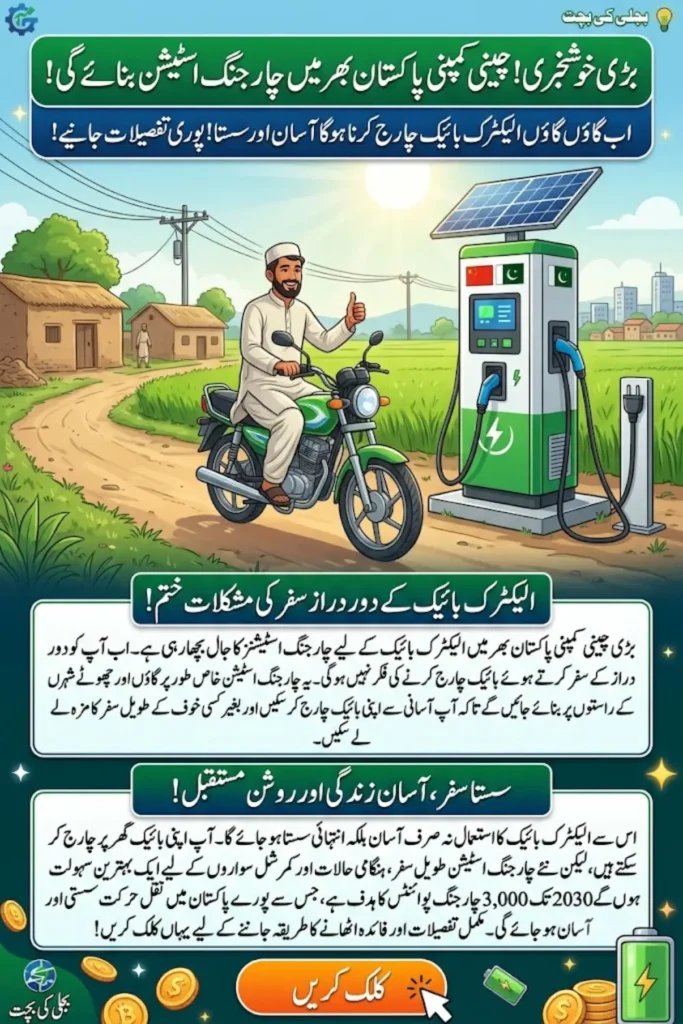
On July 22, 2026, StarCharge Energy Pakistan signed a memorandum of understanding with Bahum Global Limited, a Chinese company, to establish electric vehicle charging stations across the country. Under this agreement, Bahum Global will provide technical support while working alongside the Pakistani company to build out the charging network.
This is not the first EV charging initiative in Pakistan, but it represents another concrete step toward expanding infrastructure that has so far grown much slower than the number of electric vehicles being sold.
Also Read: Electric Bike vs Petrol Bike: How Much Money You Actually Save Every Month
Why Pakistan’s Charging Network Has Been So Limited
As of now, Pakistan has somewhere between 30 and 50 publicly accessible EV charging stations across the entire country, mostly concentrated in Karachi, Lahore, Islamabad, and Rawalpindi. For a country with a rapidly growing number of electric bikes, rickshaws, and cars, this is a very small number.
Under the New Energy Vehicle (NEV) Policy 2025-30, the government has set a target of building 3,000 charging stations nationwide by 2030, with around 240 planned for the current fiscal year alone. More than 72 licenses for charging infrastructure have already been issued under existing regulations, showing that private companies are now moving from paperwork to actual construction.
How This Chinese Partnership Fits Into the Bigger Plan
Government-issued licenses only create the legal pathway for building charging stations. Actually constructing and operating them requires real investment, technical expertise, and hardware, which is exactly where partnerships like the StarCharge and Bahum Global agreement come in.
Chinese companies bring years of experience from one of the world’s largest EV charging markets, and this kind of technology transfer can help Pakistani operators build stations faster and more reliably than starting from scratch. This agreement adds to a broader pattern of Chinese firms investing in Pakistan’s EV charging and battery-swapping sector under the wider China-Pakistan Economic Corridor framework.
Does This Affect Electric Bikes Specifically?
Most charging station announcements in Pakistan focus heavily on cars, since cars need more powerful and more expensive fast chargers. Electric bikes are different, and this actually works in their favor.
Why Electric Bikes Need Less Infrastructure
Electric bikes typically use smaller batteries than cars and can often be charged using a standard household power socket, without needing a dedicated public charging station at all. Most electric bike owners currently charge their bikes overnight at home, similar to charging a mobile phone.
This means the expanding public charging network primarily benefits electric bike owners in specific situations, rather than being a daily necessity.
When Public Charging Stations Actually Matter for Bike Owners
- Long-distance travel between cities, where charging at home is not an option.
- Commercial use, such as delivery riders or rickshaw drivers who need a quick top-up during work hours rather than waiting for a full overnight charge.
- Emergency situations, where your battery runs low unexpectedly and you need power quickly rather than pushing your bike home.
- Living in an apartment or rented accommodation without easy access to a private power outlet for overnight charging.
For daily city commuters who charge at home, this expansion is a helpful backup option rather than something that changes their daily routine.
Also Read: PAVE Phase 2 Update: Balloting Removed, Here Is What Changed
What the New Charging Tariff Means for Your Wallet
A separate but related development is the electricity tariff specifically set for EV charging stations, currently fixed at Rs. 39.7 per kilowatt-hour. This rate is designed to keep public charging affordable for both station operators and everyday users.
For an electric bike needing roughly 1.5 to 2 units to cover 40 km, a quick top-up at a public station would cost somewhere around Rs. 60 to Rs. 80, which remains far cheaper than filling a petrol tank for the same distance.
What This Means If You Are Planning to Buy an Electric Bike
If charging infrastructure has been holding you back from buying an electric bike, this expansion is a positive sign, but it does not remove the need for planning.
- Home charging will remain your primary method for daily use, regardless of how many public stations get built.
- Public stations are becoming more useful for longer trips, which is worth checking if you regularly travel between cities.
- Battery-swap stations, which are also expanding for two-wheelers, could eventually offer an even faster alternative to plug-in charging for commercial riders.
Combined with the ongoing PAVE subsidy on electric bikes, this steady growth in charging infrastructure makes electric bikes a more practical long-term choice, not just a subsidised short-term deal.
Also Read: 600 Free Electric Bikes for Top HSSC Students: Who Qualifies?
Conclusion
The StarCharge and Bahum Global partnership adds real momentum to Pakistan’s push toward 3,000 EV charging stations by 2030, backed by Chinese technical expertise and a fixed, affordable charging tariff. While most electric bike owners will still rely mainly on home charging, this expanding network makes long trips, commercial riding, and emergency charging noticeably more convenient over time.
Also Read: Govt Employees Can Get an Electric Bike for Just Rs. 10,000 – Here’s How
Frequently Asked Questions
1. Do electric bike owners need public charging stations for daily use?
Not usually. Most electric bike owners charge at home overnight, similar to a mobile phone, and only need public stations for long trips or commercial use.
2. How much does it cost to charge an electric bike at a public station?
At the current tariff of Rs. 39.7 per unit, a top-up covering around 40 km would cost roughly Rs. 60 to Rs. 80.
3. How many EV charging stations does Pakistan currently have?
Pakistan currently has an estimated 30 to 50 publicly accessible charging stations, mostly located in major cities like Karachi, Lahore, and Islamabad.
4. What is Pakistan’s target for EV charging stations?
The government aims to build 3,000 EV charging stations nationwide by 2030 under the NEV Policy 2025-30, with around 240 planned for the current fiscal year.
5. Who is involved in this new charging station agreement?
StarCharge Energy Pakistan signed the agreement with Chinese company Bahum Global Limited, which will provide technical support for building the charging network.
6. Will more charging stations lower the cost of owning an electric bike?
Charging stations mainly improve convenience rather than directly lowering costs, though a fixed, affordable public tariff does help keep charging expenses predictable
Also Read: Punjab Teachers Can Get an Electric Bike Through PTF — Full Details